Anyone arriving on this page for the first time tends to carry the same small bundle of questions. What exactly is Tower Rush, who built it, what does one go cost, and is there a way to try it for nothing?
Here is the quick answer. Tower Rush is an instant game made by Galaxsys in which you raise a building level by level and decide for yourself when to pocket the result. The price of a single round ranges from tiny to fairly serious, set by whichever casino hosts it, and a free version runs on play credits.
Everything below takes its time.
Near the top sits a reference table for anyone in a hurry. After it comes a slow walk through one round, then the three special floors, the published return figures and the limits each version writes into its own rules. The practical material follows: the demo, handheld devices, where paid rounds take place and how to keep the habit small.
None of this is meant to sell you anything. Our aim is simpler: to show how the game behaves, including how it takes money away, so you can judge whether it deserves a slot in your evening.
Key facts about Tower Rush
Some readers want the outline and nothing more. The grid below puts the essentials side by side, so a single detail can be checked in seconds.
| Feature | Tower Rush |
|---|---|
| Developer | Galaxsys |
| Game type | Crash-style instant title, played floor by floor |
| Release | 2026 |
| RTP | A published spread of 96.1% to 97.65%, tied to the installed version |
| Stakes | From £0.09 up to £85 a round, within each casino's settings |
| Special floors | Frozen Floor, Temple Floor, Triple Build |
| Auto cash-out | Available, using a target multiplier picked in advance |
| Devices | Desktop computers, phones and tablets via the browser |
A couple of rows need more room than a cell allows. The return figure appears as a span because Galaxsys supplies more than one configuration, and operators pick the one they want. Stakes behave similarly: the studio fixes the outer edges, and every casino places its own lowest and highest bet somewhere between them.
Equally telling is what the grid omits. There is no top multiplier, no largest payout and no volatility tag. Those details do exist, yet they belong to the rules of each individual build, and a figure printed on a general page could easily clash with the copy you load.
Every row is unpacked in a later section.
The idea behind the game
Take away the graphics and Tower Rush comes down to a single tension. Every extra storey adds value, and every extra storey also invites the fall.
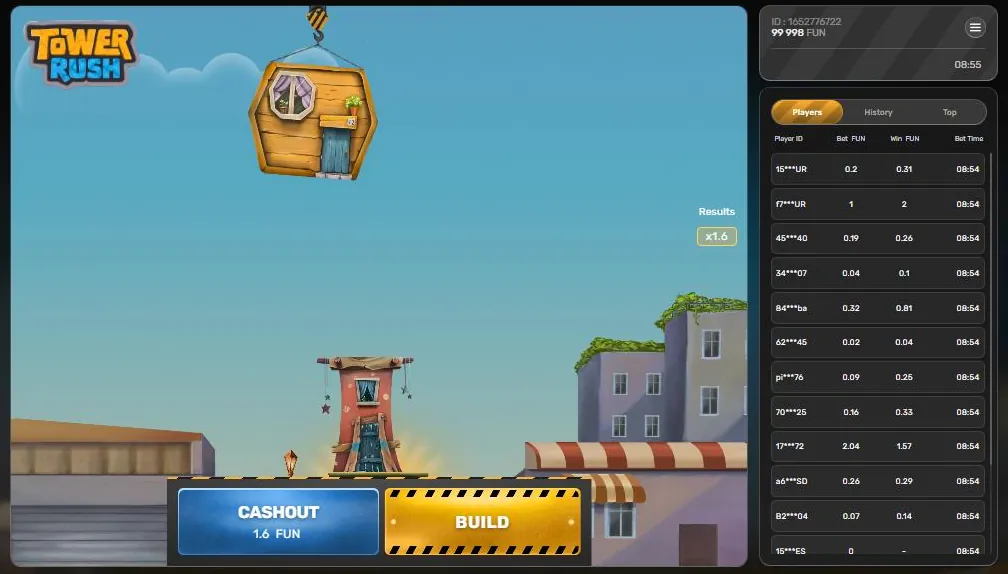
A round opens on bare ground. Levels go up in sequence, and each one lifts the multiplier on your stake a notch. So far, so pleasant. The difficulty is that each addition also makes the following placement more dangerous, so height never buys safety. The structure simply grows richer and shakier together.
You hold one real lever, and that lever is timing. For as long as the building stands, cashing out stays open to you, and you leave with whatever the multiplier reads. Hesitate past that point and the building drops, taking the stake for that round along with it.
That is what places the game among crash titles. In the classic versions, a curve or a rocket climbs by itself while you watch and react. Here, the climb is cut into separate storeys, which hands you a distinct decision at each step rather than one smooth, nervous stretch. There are no reels, no paylines and nothing that survives from one round into the next.
Galaxsys brought Tower Rush out in 2026 as part of its instant range, apart from anything resembling a slot.
One round of Tower Rush, step by step
Tracing a single round from the first click to the last makes the logic far clearer, so here it is in order.
Begin with the stake. Before anything happens, you settle on what the round will cost. It has to respect your operator's own minimum and maximum, both of which fall within a band that starts at £0.09 and tops out at £85.
Choose next whether automatic collection should be switched on. If you would like the game to close things out at a particular multiplier, enter that figure now. If not, collecting will be your job.
The round then starts on empty ground. With nothing built, nothing can be collected either.
Levels begin to rise. Every new storey pushes the multiplier a little further. Each one also raises the chance that its successor brings everything down.
This is the point where your choice counts. Up to the instant of a fall, you may collect whenever you like, and the payment equals your stake times whatever multiplier is showing as you collect.
Let us attach numbers, strictly as an illustration and not as what any given floor is worth. Suppose you staked £4.3 and collected once the multiplier showed x1.80. You would receive £7.7. Had the collapse come before you collected, those £4.3 would have vanished.
Only two endings exist. You either collected in time, or the structure fell first and the round's stake went with it. Nothing is partly returned and nothing rolls forward.
After that, a fresh plot appears and the process restarts with no memory at all. A towering result last time makes the next building neither sturdier nor weaker.
Frozen Floor, Temple Floor and Triple Build
Ordinary storeys add height and move the multiplier along. Three kinds behave differently, and they may surface mid-round without you doing anything to trigger them.
| Floor | What it does | What to remember |
|---|---|---|
| Frozen Floor | Secures the winnings that were reached on that level | It shields the amount built so far; anything gained above it is still exposed |
| Temple Floor | Its arrival gives the multiplier a behaviour of its own, so the climb no longer follows the usual pattern | Consult the rules of your installed copy for the precise effect |
| Triple Build | Has a distinct multiplier behaviour that shifts how the multiplier progresses | It turns up only sometimes, so never size a stake around it |
The frozen level is the easiest of the trio to grasp. When it shows up, the sum built by that height is secured. Should the building fall later on, that protected sum stays yours. It works like a marker partway up, not like an invitation to keep climbing forever.
The other two concern motion more than protection. Each one reshapes how the multiplier advances for the remainder of that round. We avoid quoting any values for them here on purpose, since the in-game rules attached to your installed build are the dependable source for exactly what they do.
All three share one trait: they are chances, never fixtures. A given round might feature one of them or none whatsoever. Nothing earlier in your session reveals when the next might arrive, and nudging your stake upward in the hope of meeting one is a habit best left alone.
If the special floors are unfamiliar, try the demo first. Seeing how a round plays out after one of them shows up, with no real money at risk, usually teaches more than any grid of text.
Return to player in Tower Rush
RTP, short for return to player, is the slice of all stakes a title is designed to return to its players over a huge volume of rounds. Read it as a long-horizon average, never as a forecast for tonight.
Galaxsys gives Tower Rush a span instead of a single fixed value, with 96.1% as its lowest setting and 97.65% as its highest. The reasoning is practical. The studio supplies several configurations, and each operator installs whichever it prefers, which means two sites can carry the identical game with different return settings.
How do you know which figure applies? Look at the rules of the build you have open. Checking takes well under a minute before any paid round, and the number you find there is the only one that genuinely describes your copy.
RTP reveals nothing about how one session will turn out, since short stretches of play swing sharply both ways. It does not mean you recover 96 or 97 out of every 100 staked. And no amount of playing time converts it into guaranteed profit.
Where it does help is in comparing one installation against another. Given the choice, the upper end of the span is kinder to you over time.
Stake range and in-game rules
A round of Tower Rush is priced anywhere upwards of £0.09, with £85 as the dearest option. Those are the absolute edges. Inside them, every operator picks its own minimum and maximum, which is why the cheapest bet at one site may be pricier elsewhere.
Picking a stake has more to do with your budget than with the game. A reasonable rule is to choose an amount that allows a decent number of rounds without any single loss hurting. If one collapse would genuinely sting, the figure is probably set too high.
Three details are missing from this page by design: volatility, the ceiling on multipliers and the biggest possible payout. Each version lists all three inside its own rules, which is where you should look them up. Quoting numbers here could leave you with figures that do not match the build you are actually running.
The same rules section also explains how the special floors behave and states the RTP of that particular setup. It is brief and worth reading before you spend anything.
Auto cash-out in Tower Rush
Collecting by hand works perfectly well, but rounds pass quickly and concentration slips. That is the gap automatic collection is designed to fill.
The mechanism is easy to follow. Before a round begins, you type the multiplier you are aiming for. Should the building reach it while still upright, the game banks your winnings without further input. Should it fall short, the stake is lost exactly as it would be with the option switched off.
The main benefit is discipline. Fixing an exit point while you are calm usually leads to sounder choices than fixing it mid-round, when a climbing number makes one more storey look irresistible. A preset target takes that pull away.
On a phone it earns its keep twice over, since a small display and a patchy signal can turn a well-judged manual tap into a missed one.
The limits deserve stating plainly. Automatic collection does nothing to make a collapse less likely, and a loftier target only means more time exposed to one. It is a way to keep to a plan, not a route to winning. Nothing stops you from collecting manually earlier if you change your mind.
Free play mode
Wanting to watch a round before paying for one is a perfectly sound instinct. A free version of Tower Rush can be found on many casino sites and here on our page, running on virtual credits instead of cash.
It behaves just like the paid edition. Storeys rise in the same fashion, the multiplier climbs as it would with money on the line, and collapses land just as suddenly. Special floors can appear too, so it is a handy place to see what they look like in action.
Several things are best learned here. You can rehearse manual timing, test automatic collection at various targets and discover how fast a balance can shrink over a session. None of it costs anything.
Keep one point in proportion. Demo outcomes mean no more than real ones, and a run of good fortune with play credits tells you nothing about your next paid round. Availability also differs, as some operators list the free version while others offer only real-money rounds.
Mobile and desktop play
Everything runs inside a browser, so installation is never part of the process. On a computer, Tower Rush opens much like any web page. On phones and tablets, it loads in the mobile browser and reshapes itself to the narrower screen.
For that reason, treat any request to download a dedicated app or an APK file with suspicion. Tower Rush does not require one, and such files from unknown sources can pose genuine dangers to your device and your accounts.
A handful of mobile habits make life easier. A steady connection matters, because rounds are brief and a lost signal at a bad moment is maddening. Automatic collection suits small screens especially well. And since a phone is never far away, a firmer limit on session length makes sense than you might need at a desk.
Real-money play at licensed casinos
Galaxsys builds the game but does not accept wagers on it. Paid rounds happen only at licensed operators whose lobby includes Galaxsys titles, and only for players who have reached 18.
The route is generally the same. You sign up with a licensed operator, pass its identity verification, fund the account and then locate Tower Rush, normally filed under instant or crash games. Account conditions, payment options and checks are matters for the casino, not for the studio.
Choosing a venue calls for a few checks that outweigh any promotional banner. Confirm the operator is properly licensed and accepts customers from your location. Compare the bet limits it applies here, since they differ. Find out which version, and therefore which RTP, it has installed.
Approach bonuses with care. Terms frequently reduce the weight instant games carry in wagering requirements, rule certain titles out altogether or restrict your bet size while the offer runs. Go through those conditions before saying yes.
Avoid unlicensed operators, prediction tools, bots and the paid tip channels that promise them. Nothing of that kind can see a random collapse coming.
Safer play with Tower Rush
Brief Tower Rush rounds seem harmless individually. The problem lies in how they accumulate, letting a session stretch far longer and cost far more than intended while no single round ever feels significant.
Preparation therefore matters most. Before starting, fix a spending cap plus a time cap, and refuse to move either. Your budget is money you can afford to lose, never a figure to win back. Once it is used up, you stop for the day.
Pauses are more useful than most people assume. Stepping back for a few minutes breaks the rhythm of rapid rounds and helps you decide honestly whether carrying on still appeals.
Licensed operators supply tools built for exactly this: deposit caps, time reminders and limits, and frequently self-exclusion as well. Switching them on while you feel steady is much simpler than hunting for them during a losing streak.
Learn the usual warning signs. Chasing losses, raising stakes to win money back, playing while tired or upset, and concealing the hours involved all indicate that gambling has drifted away from entertainment.
If the fun has gone, contact a specialist support service run by trained professionals. Talking it through with a trained person is a sensible step, not a weakness.
Points worth knowing
- When the tower collapses, the entire stake of that round is gone.
- Rounds are independent and outcomes random, so earlier towers say nothing about when the next collapse will come.
- Return figures vary with the installed version; the exact one is printed in the rules of whichever copy you load.
- Volatility, the ceiling on multipliers and the largest payout are stated in each build's own rules, never in general overviews.
- A special floor can turn up in any round, yet none of them is promised.
- Automatic collection keeps you to a plan; it leaves the odds untouched.
- Minimum and maximum bets vary from one casino to the next, always inside the published band.
- No system, method or betting pattern can guarantee a win at Tower Rush.
- Predictors, bots, tip channels and unofficial downloads cannot glimpse a random result ahead of time.
- Frequent missteps include hunting for huge multipliers, ignoring the rules and making rushed calls after a loss.